
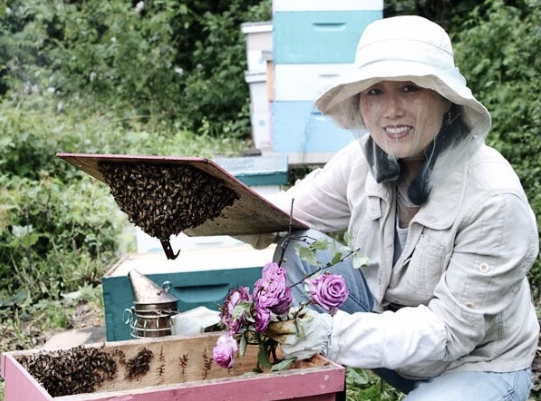
Ruth Harrigan is a Queens-based beekeeper with hives across NYC. Her company HoneyGramz sells honey from her beehives in Queens, Brooklyn and Staten Island, while also donating a percentage of profits towards efforts to save bee populations. Ruth is also an avid gardener, both in her own yard and in community gardens across NYC. Ruth and I had a zoom interview just as NYC’s second COVID-19 surge was peaking.
So after working on Wall Street for 20 years, how were you inspired to be a beekeeper in Queens? You had no experience, yet you are now one of NYC’s top beekeepers and honey makers. “I got into beekeeping because Leah (my youngest daughter) wanted a dog for her birthday. I found her chickens instead, but in doing research on how to raise chickens, I stumbled upon a petition to legalize beekeeping in our city and it led me to a beekeeping class. I realized it is really something that I was interested in. New York City made beekeeping legal in March of 2010. I started with two hives in my friend’s backyard in Douglaston (Queens). At first it was just a hobby, then in 2013 I got laid off from my job on Wall Street. I decided to pursue beekeeping full-time and created a line of honey bears called Honey Grams. And my mission is really to help save the bees because they are dying.”
That sounds like beekeeping helped you be resilient in the face of a major job loss. You also work with community gardening at a Queens high school? “Yes, at John Bowne High School in Flushing, Queens. The school has a five acre farm. No one knows about it. It sits between Queens College, John Bowne High School and Townsend Harris High School. John Bowne High School has the only agriculture curriculum in New York City. They have a henhouse, vegetables, rabbits, alpacas, peacocks, goats. They sell all their vegetable produce on Main Street during the summer to local Flushing residents.”
So how do you think that high school students learning to farm intersects with the idea of resilience? “Even in a city you’re able to cultivate food that can be enjoyed by locals. So you don’t have to go to a rural area to produce food. You can do these farming techniques and grow food and have animals in a city – New York City. They’re doing it in Flushing and they’ve been doing it for a very long time. Agriculturally, they are doing what every family in New York City should do. Even if you grow a little bit of herbs on your windowsill, it means a lot.”
Has the agenda of community farming changed since the pandemic started? “Well that’s the thing. Farming doesn’t stop because of COVID. In Brooklyn, all the teachers at the Environment Center went to work every day because they had to tend the animals. Interesting enough, because kids weren’t allowed to come to the Environmental Center last year, all their frogs had tadpoles. That tells you nature needs to rest, it can’t be disturbed by humans. The Environmental Center is a learning center – we use the frogs as a learning experience. But when everything shut down, we learned something that we wouldn’t have ever known without the COVID disturbance. They all gave birth. Whereas in the past years, they had to replenish their frogs. They never gave birth within the Environmental Center because of noise or you know, just human interference.”
So COVID allowed humans to learn more about animal resiliency! Do you think that when food is a problem, people can try to do something about it? Food definitely got scarce for many people in the past year. “You can do something about it. If you’re lucky enough to have a garden, plant food. In dire times, we look for ways to feed ourselves. Farming has been around as long as humans …the most important thing is that we have to eat. You can do it on a small scale. If you don’t have the property, seek out community gardens. Seek out empty lots in your neighborhood. Invest time. Transform empty spots.”
It sounds like gardening creates culture and connections within a community. Is that resiliency? “Yes, when you garden, you will naturally attract other people like you – that’s how you form a community. Someone will come to the garden to water it. Someone else will come to help harvest, some to pickle, some to package it. Gardening starts from planting one seed, right? It takes one person to start that. Then people will come to join in. You know, the person who helps me the most is my neighbor across the street Harold. He’s 96 years old! He didn’t know anything about bees, but he’s been so excited to learn. Before COVID, he came to the beehives with me and learned all about beekeeping. And he thanked ME for that! Meanwhile, I thank HIM for helping me! It’s mutual. You’re never too old to learn from a 96 year old.”
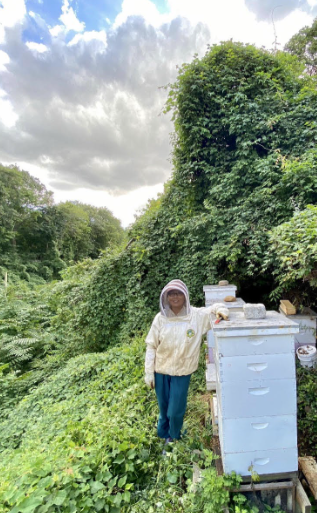
I’m learning that even in hard times, you can strengthen community. If you have a community garden, everyone can profit, especially during a pandemic. And it’s all healthy! “Exactly. How great is it to be outside, in the sun and fresh air? It’s healthy. You don’t have to be part of a huge group to be close to each other, but you can nurture a garden together, apart.”
How would you define community resiliency during COVID-19? “Not to let a pandemic cripple you. You can take time to stop and think, but then you have to move on. Not pretending it’s not happening, but finding another path to reach your goal.”
Parts of this interview have been condensed.
Reflections
According to a Wall Street Journal article, “there is no money in beekeeping.” Although Ruth’s on-line honey sales is one of the financial exceptions to this headline, that isn’t exactly the point. Honey bees, vital for agriculture and pollination of all kinds, even in urban environments, are irrefutably indispensable. They are a core building block in feeding humanity, but especially critical in feeding the resilience of NYC. With knowledge and protection of bees, as well as community gardens for both teaching and growing, New Yorkers eat healthier, live more holistic lifestyles and create more integrated urban habitats to thrive in. For a full list of beekeepers and their honey products, visit the NYC Food Policy Center at https://www.nycfoodpolicy.org/beekeeping-in-nyc/
As for community gardens, GrowNYC has built over 100 community gardens located across the city, including in public housing developments and senior centers – https://www.grownyc.org/gardens/our-community-gardens While a community garden itself can’t feed an entire city, it does provide outdoor physical activity, fresh seasonal food, learning and personal growth opportunities, and most of all, connectivity among neighbors on an intimate scale. That is Feeding Resilience. At the end of my interview with Ruth, she told me a quick story about Harold, her 96 year-old neighbor. “Harold asked me what I was doing with all my honey pails. He drilled holes on the bottom, filled them with dirt and planted one vegetable in each. He created this massive garden in his backyard. Okay…so there’s no excuses.”