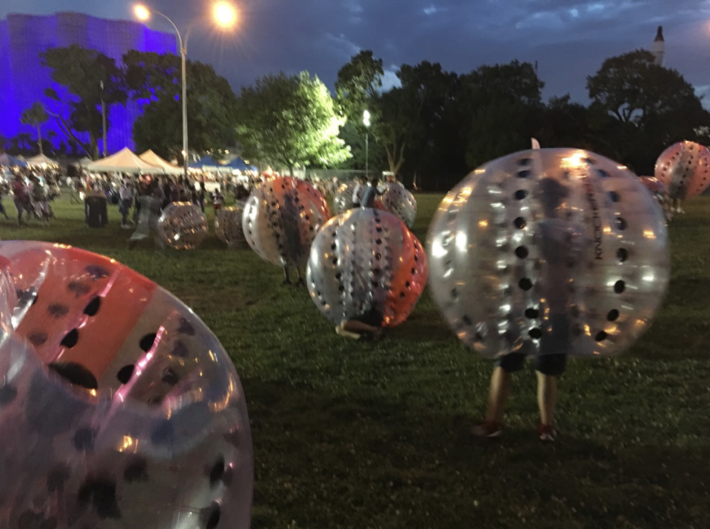
The site of a hundred independent food vendors across the grassy lawn of Flushing Meadow Park always makes my stomach growl in eager anticipation. This is the Queens Night Market, a cultural festival that offers food from over 90 countries through NY’s immigrant communities. John Wang is the Founder. Only six years old, it almost immediately became an icon of summertime in Queens, a destination for local residents and visitors, from all socio-economic classes. With food prices capped at $5 per portion, live music, endless lawn, and only the mosquitoes to bother anyone, the Queens Night Market is the go-to Saturday night destination for me, my family, my friends and 10,000 weekly visitors. A big fan of the Night Market, I was thrilled to Zoom chat with John Wang.
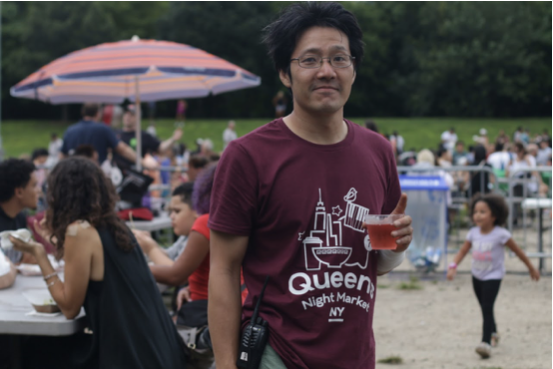
Besides being an amazing night out, when I think about the Queens Night Market, connectivity comes to my mind. How does the sharing of food at the Night Market connect people? Specifically, does the sharing of food connect “immigrants” with other New Yorkers who may not be familiar with that specific culture? “It falls into a couple categories of connectivity. If you look around, independently and regardless of the type of food that’s being served, the sharing of this food is successful in creating an event or community space where strangers are compelled to talk to each other for one reason or another. “What are you eating or what tent should I try?” Our picnic tables seem to make people pretty willing to share with other folks. And, maybe that’s because of the food’s diversity or just the ambiance or the different people that come. We have the most diverse mix of vendors, but also the most diverse mix of visitors. And I think these go hand-in-hand. Our event has a pretty broad spectrum of age demographics. It’s also similar with ethnic or racial demographics. Often what happens is some kids or young adults read about it and want their parents or grandparents to go with them. The diversity of the event makes people feel comfortable because there’s something that resonates with them, geographically or culinarily that they feel comfortable with. Three or four years ago we had a Mauritian vendor, probably the first of the tri-state area. Whatever small population from Mauritius there was in the tri-state area, they all came to the event. But then it’s probably not enough to fill you up. What else can I try to eat since I’m already here? But then of course there are other people that come specifically to eat something they’ve never eaten right? A little bit more adventurous folks. All of these are how the curation of diversity creates connectivity.“
While I don’t say it aloud to John, his statement that “the curation of diversity creates connectivity” is so very powerful, an opportunity that only Queens could offer. “The mission I gave myself when I started the Queens night market was to have one vendor for every country that’s represented here in New York City. Two years ago, we had someone applying from Papua New Guinea, which is super cool.”
In my research, I’ve encountered another area of connectivity. Does the retention of recipes and food traditions within a home connect immigrants to the cultures they may have left in their original country? “So we have a cookbook. There’s this tension – the younger generation wants to pay homage to their parents and their grandparents, but the ones in it (who want) to be successful food entrepreneurs often feel compelled to tweak the recipes or make it more accessible for America pallets. Or taking short-cuts or liberties to get it to scale. One of the Korean vendors in the book was convinced that everything needed to have a lot of sugar, and spice levels couldn’t be nearly as much as they were accustomed to. So, on the one hand, there is a tension between people’s intentions to do things exactly as they were passed down through generations, and then you have other folks who feel that to be inspired by tradition is enough In order to be really successful, they need to make it modern, appealing or palatable to modern America. My point in the curation process was specifically to hold on to some of these traditions that are probably being lost.”
Nothing at the Night Market costs more than $5 right? What was the goal of putting a price cap on menu items? “Yes, affordability is super important because without that you have a target demographic that is greatly narrowed down. When I started in 2015, I created the $5 price cap. Unfortunately even at $5 some people are probably price
When I think about the $5 price cap, apart from democratizing the Night Market, I’m struck that the amazing food, freshly made at reasonable prices, demonstrates that healthy food on a budget doesn’t have to be fast food. What do you say to people who think that they can only afford processed food or fast food.? “That’s very complicated. I don’t want to pretend that everything in the Night Market is healthy. There is a lot of deep fried and fatty foods for sure, but also tons of fun salad stuff. You can definitely find healthy food there. I am intentionally artificial minimizing or decreasing vendors profit margins. The same dishes elsewhere in New York City will probably cost ten or fifteen dollars, two or three times what they’re charging at the Queens Night Market. That’s by design. When I started the event, it meant nothing to me if it wasn’t sort of accessible and affordable.”
I keep finding that food contributes to community resiliency. I want to know how you would define community resiliency. “It’s a lot about having bonds and solidarity that don’t fracture with crisis. Over the last few years we’ve seen crises and socio-political developments really drive wedges between communities. That is a case of communities not being resilient. A community being resilient is New York during the pandemic. The healthcare salute was an example of solidarity and community resilience. We are using food to create bridges that didn’t exist before.”
Due to COVID, there was no Queens Night Market last summer. How did this impact the vendors? And in what ways did it change your goals? “My agenda is to constantly increase the diversity of representation of the event, so when the pandemic canceled the market, I’m not sure it changed the goals. I took on other projects that were personally important to me. We did the Fuel The Front Lines Initiative where we hired our vendors to feed healthcare workers. We did a “ Queens gets counted” borough-wide census event. So the Night Market hit pause and we took on other projects that are in the category of social mission. In terms of how it affected the vendors, it was terrible. Anecdotally, maybe half or two-thirds of the vendors have just completely dropped out of the industry or dropped their entrepreneurial plans. And I think it’ll be years until that even remotely rebounds. There’s lots of vendors who lost family members and friends.”
Will the Night Market open this summer? “I would be surprised if it doesn’t in some capacity! It’ll be scaled back and sad in some ways.”
Well, I’m looking forward to it and I’ll be there! “If you show up, you can ask a few folks where to find me. I know I can’t buy you a drink yet, but I’ll teach you something else.”
Link to the Queens Night Market Website
Parts of this interview have been condensed.
Reflections
Inspired by Taiwanese night markets, the Queens Night Market is one of those things that seems like it was always meant to be. Only six years old, it feels like it has always been a New York summer tradition. Taking up a giant lawn space in Flushing Meadow Park, which would otherwise be unused and a bit sad, the Queens Night Market is Queens. Diverse, multicultural, multi-generational, delicious, cheap, stimulating, educational and unique; this is Queens. It is more than just a fantastic way to spend a sticky summer night. The food, the vendors and the visitors embody authentic diversity, a resilient community of native New Yorkers and immigrants sharing their common humanity.
The Fuel the Frontline initiative https://www.fuelthefrontline.com was founded in 2020 as a way for anyone to “send a care package” of food to a front line worker – anyone without the option to work from home as the pandemic struck America.