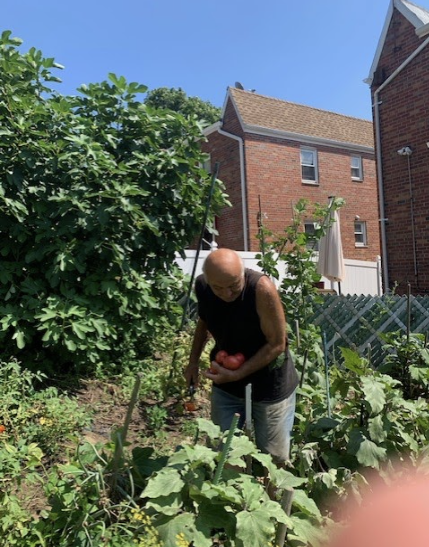
Antonio Cintorino was a long-time beloved family friend and original inspiration for my project idea. For as long as I can remember, summers meant this gentle, quiet man grew mountains of giant fruit and vegetables in his tiny Queens yard. He widely shared his produce with everyone – family, neighbors, mail carriers, dog walkers – really anyone who admired his garden which sprouted not just from the ground, but in pots and containers perched on every available surface. Much of his fruit and vegetables were Sicilian in variety – lemons, squashes, beans, herbs – the size and flavor of which we simply don’t have in America. Summer in NYC meant that there would always be baskets of enormous vegetables on the kitchen counter of my home and he would never visit without bringing more. Antonio’s green thumb and the ease with which he gardened belied his incredible knowledge and year-round dedication to his garden. During the harsh NY winter, he cultivated roots and seeds indoors until it became warm enough for him to begin nurturing them as copious crops that would eventually be distributed to others. Having immigrated from Sicily in 1963, Antonio was a man of very few words and especially limited in speaking English. I spent an August afternoon videoing him in his garden, as he proudly showed me his plants, telling me how easy it was. Although his answers are brief, try to imagine the August green of his garden surrounded by concrete houses, Antonio smiling at my questions and shrugging shyly as he filled bags of tomatoes for me to bring home.
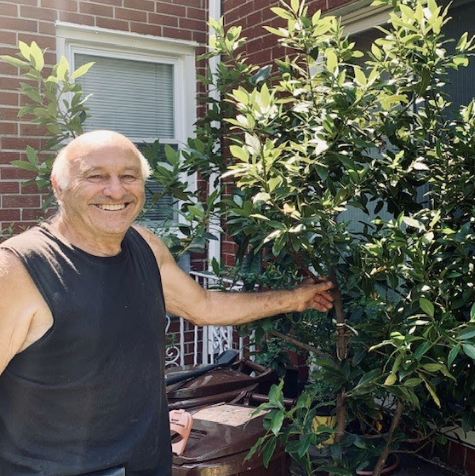
Did you garden in Sicily? “Yeah, I shared a garden with my father.” Is that how you were taught? “Yeah, my parents taught me because everyone in Sicily has gardens. In Sicily we had a big farm and made cheese from our cows.” Did you immediately start gardening when you arrived in New York? “Yes, right when I got my house here, I began gardening.” So what do you plant here? “I plant tomatoes, eggplants, sweet chilis, squashes, cucumbers, basil, oregano.” Did you plant any other vegetables in Italy that you can’t grow here? “I can’t plant lemons in New York. Over there, you can plant anything. You can grow anything in Sicily. Figs are also very tough to grow in New York because they die very easy in bad weather. ” What is your favorite thing to grow? “Everything really, but you know, in the wintertime, you can’t grow anything here.” What is the easiest to grow? “If you got the ground, everything is easy.” How do you get your vegetables so big? “You just have to put fertilizer and really pay attention to the plants.” Do you cook with everything you grow? “Sometimes I cook for my family and sometimes I give it to my neighbors. To you. To your grandmother. And to the rest of my family.” How does gardening make you feel? “Well I like it because you know, you can watch the plants grow. You do things, you can work with your hands, and you see which plants work and which don’t. I like being outside in the sun and fresh air.” Why did you come here from Sicily? “Well, because they said everyone in New York has a better life here. But here you have to work much harder compared to people in Sicily. They have much easier lives.” Do you miss Sicily? “Yeah, sometimes I do. But I visit my family there often and my garden reminds me of it, like a little Sicily.”
Parts of this interview have been condensed.
Reflections
For over fifty years, Antonio’s Sicilian garden in Queens has been his connection to the Italian countryside and culture he left behind. Cultivating, eating and living a lifestyle reminiscent of Sicily empowered Antonio’s resilience to the hardships of life as a hard-working, uneducated immigrant in NY. But Antonio’s garden also enabled his connectivity to other New Yorkers of all cultural backgrounds, integrating him into his diverse and constantly changing Queens neighborhood. Antonio passed away suddenly during NYC’s second COVID wave in January 2021. Upon hearing the news, the neighborhood mail carrier, a Chinese immigrant and frequent recipient of Antonio’s produce and clippings, sat down to cry. Then he stood up and assured the elderly neighbors that in the spring he would bring them clippings of Antonio’s clippings. He would help plant Antonio’s favorite tomatoes and raspberries, basil and squashes. He would even uncover the fig trees that Antonio had so carefully wrapped and topped with plastic buckets in the autumn. The connectivity set in motion by Antonio’s garden will continue to feed resilience, albeit without his big smile and shy shrug.