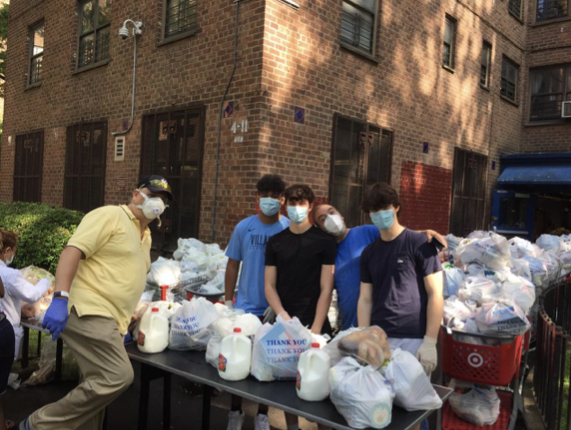
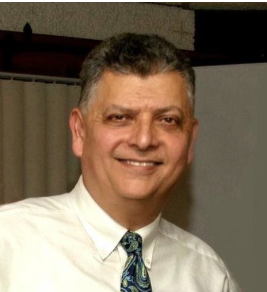
Victor Dadras is an urban architect specializing in Main Street Downtown Revitalization Planning, a Partner at Dadras Architects and Adjunct Professor at the Parsons School of Design/The New School. He is also a longtime community leader in Queens, Founder of the Douglaston Local Development Corporation (DLDC) and impromptu organizer of food pantries in Northeast Queens. Victor and I sat 6 feet apart at a busy Mexican cafe to talk about filling the void for food pantry services in northeast Queens.
The Douglaston Plaza is a commercial and civic space managed by your organization, normally hosting farmer’s markets, movie nights, and festivals. COVID stopped all that. The Little Free Library was immediately converted into a food pantry. What was the inspiration for that switch? “The Little Free Library is an international program for people to share books in a community. When COVID hit, sharing books seemed like a bad idea – we were worried about touch. I heard other people had converted their Little Free Libraries to Little Free Pantries. When we started, I thought the Little Free Pantry might just be symbolic. We started filling it ourselves – we would run to the supermarket or add things from our kitchens – and at first we had to fill it maybe twice a week. As the pandemic endured, the timeframe when it emptied got shorter and shorter. And now it literally empties every day.”
I was surprised that a neighborhood like Douglaston, which is affluent relative to most of Queens, has food pantry demand. “We don’t ask and we don’t monitor, but anecdotally we’ve seen different members of our community – elderly, young families, single people. There certainly has been a great need judging from how often the food is taken. You are right, the perception of Douglaston is an upper middle class section of New York City. Certainly we have million dollar homes. But when we talk about food insecurity – no one is going to sell their house to eat. You might live in a house that you bought 40 or 50 years ago if you are elderly. Young families have lost their jobs. People live above stores, people work as day laborers in the neighborhood. And many of the business people here don’t live in the neighborhood – they have friends and family who might be in need. So we don’t ask if the need is there…there’s a greater need than we think.”
How does food insecurity manifest itself, particularly in light of high rates of unemployment and closed businesses? “If you lose your job and you have government assistance – three or four hundred dollars a week on top of unemployment benefits – you have to make choices between paying rent, electric, heating bills, taking the subway or bus to work. Food insecure means you have to cut back on the choice to buy food. We try to provide free food so you don’t have to choose.”
Other things come first? “Right, someone might have to make a choice about buying medicine or buying food. Paying rent or buying food. We are not talking about luxury items or going on vacation. Food security is the ability to feed yourself and not have to make those kinds of choices.”
The DLDC has expanded from stocking the Little Free Pantry to partnering with La Jornada Food Pantry and Zion Episcopal Church to provide a weekly food pantry service. “The Borough President’s office contacted us about a program with Fresh Direct – perishables and non perishables in sealed boxes – to distribute to community groups. We partnered a few times during the summer to distribute the boxes with Zion Episcopal Church. Then La Jornada – a big food pantry based out of Flushing serving a really needy community of 7,000 thousand people – contacted us….with new government funding, they could now supply food for a regular distribution. We’ve just started this new partnership – we’re not sure what the demand will be.”
There is a mistaken idea that people with cars don’t need food pantries. That’s obviously not true, since we see many people coming for food in their cars. What are the choices and sacrifices people make to decide what is necessary? “In our society, a car is not a luxury. In Houston, Texas, drive-through food pantries had lines that literally went for miles. In Los Angeles, before they were driving up for vaccines, they were driving up for food at Dodger Stadium The car is a necessity to be mobile, not a luxury. And here in Northeast Queens, there is no subway and only one bus line. If you ask someone to sell their car to eat, they won’t be able to get to work. These are the kinds of choices we don’t want people to have to make.”
What does resilience mean to you? “Resiliency to me means we provide for ourselves, we are doing things more locally based. I heard that during WWII, it was a patriotic thing to grow your own food. To help the war effort, people tried not to take food that was to be used as other resources. When you have a fragile situation, a crisis exposes weakness. COVID exposed weaknesses. We need to rethink how we source and distribute food. We can grow fresh food locally, in urban, school or community gardens. Resiliency should keep food local. Resilience should also help people understand food better. A doctor told me that she told a patient to eat more broccoli and the kid had no idea what broccoli is. My Parsons students study neighborhoods and while they identify lots of sources of foods, most is fast food, processed food, in underprivileged neighborhoods, which leads to obesity, cardiac illness, diabetes, kids out of shape. Resiliency is the ability to prevent bad things from happening and solve problems yourself when things do happen.”
Parts of this interview have been condensed.
Reflections
As the pandemic went into full swing, tens of thousands of New Yorkers lined up for food pantry services. The NYT estimated that up to 1.5 million New Yorkers “could not afford food.” In the spring of 2020, during NYC On Pause and after I tested positive for COVID-19 antibodies, I started to volunteer at a food pantry in Flushing, Queens, run by La Jornada, a well-established and long-running charity organization – http://lajornadany.org Thousands of people lined up for hours on Saturdays in a high-density, high-immigrant community near the James Bland Houses. Just a few miles to the east, the food pantry services organized by Victor in the winter/spring 2021 attracted a different demographic – strikingly different by virtue of their car mobility. From SUVs to a few Mercedes, this pantry service was serving a population of residents who by outward appearances “didn’t need food.” Yet economic insecurity and job loss forces people to prioritise expenses. In order to keep their jobs, a car is necessary, and in some cases, car payments are more vital than food purchases. Reiterating this first-hand experience at Victor’s DLDC/Zion Church Food Pantry, the NYT ran an article titled “Just Because I Have a Car, Doesn’t Mean I Have Enough Money to Buy Food.” – https://www.nytimes.com/2020/09/03/us/food-pantries-hunger-us.html Among the many powerful points made in this article, the success of a drive-up food pantry in a relatively affluent community of NYC exemplifies this point: “The pandemic has exposed the fragile nature of success for millions of Americans: material markers of outward stability, if not prosperity, but next to nothing to fall back on when times get tough.”
Towards the end of our interview, Victor and I just chatted about food. I mentioned one of my favorite Mexican restaurants, Tortilleria Nixtamal in Corona, Queens – https://www.facebook.com/tortillerianixtamal/. Normally a Oaxacan hand-ground tortilla distributor, during the pandemic they started to make and distribute full meals, to the great delight of many. Victor pointed out “Just being in Queens, the most diverse county in the country, means we even have different food pantry meals than in other parts of the country!” In this vein, The Migrant Kitchen is a superb example of pantry meals prepared for emergency and front-line NYC workers based on fresh, culturally diverse recipes – https://www.themigrantkitchennyc.com. A Latin-Fusion “Food for Social Good” kitchen, they “pay homage” to Middle Eastern and Latin American food traditions with pantry meals such as Carnitas Shawarma. What better way to fortify an emergency worker’s resilience than with fresh food, bursting with flavor, history and comfort? Feeding Resilience through food helps to address hunger, a hidden hardship for millions.